Opinion: Africa Is Fuelling a Billion-Dollar Music Industry — So Why Are African Artists Still Getting Paid Pennies?

Let’s stop celebrating the illusion.
African music is not “rising.” It has already taken over.
From Accra to Lagos, from London to New York, African sound is everywhere — streaming, clubs, festivals, commercials.
But here’s the part nobody wants to confront:
African music is making billions globally — yet African artists are still being paid like they are local acts.
That is not growth.
That is extraction.
The Streaming Scam Nobody Wants to Admit
We were told streaming would democratize music.
Upload your song. Reach the world. Get paid.
But the numbers don’t lie.
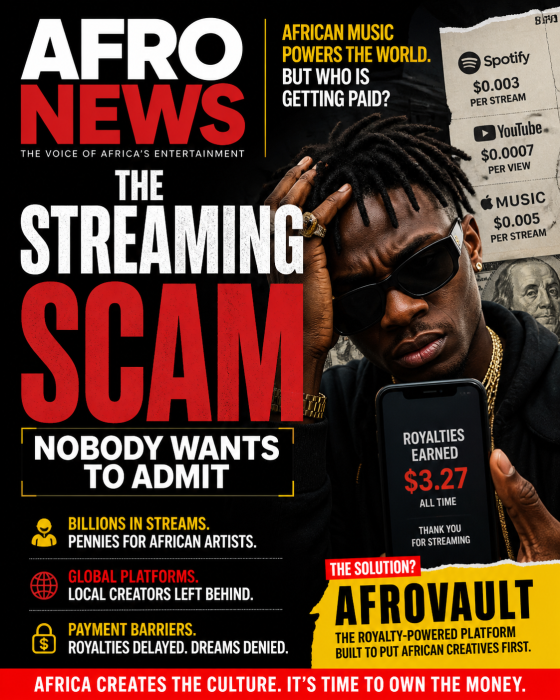
- Spotify pays roughly $0.003 – $0.005 per stream
- That means 1 million streams = about $3,000 – $5,000 (before splits)
- YouTube averages even less — often $1,000 – $2,000 per million views
Now break that down:
- Distributor takes a cut
- Label takes a cut
- Publisher takes a cut
- Management takes a cut
By the time it reaches the artist — especially an African independent artist — the earnings are often shockingly small.
And here’s the real issue:
👉 Those payouts are already low globally — but African artists face additional barriers collecting them fully.
The Real Lockout: Payment Infrastructure
This is where it gets uncomfortable.
Even when African artists generate revenue, getting paid efficiently is a problem.
Why?
Because the global financial system they depend on is not built for them.
- Google Pay — limited functionality across Africa
- Apple Pay — not widely supported across African markets
- Cross-border payments — slow, expensive, fragmented
- Banking systems — inconsistent and often incompatible
So what happens?
👉 Money is generated globally
👉 Processed globally
👉 But struggles to land properly in African hands
That is not a coincidence. That is a structural choke point.
Sign Away Your Rights — Or Stay Broke
Let’s be brutally honest.
If an African artist wants to fully maximize their earnings, they are often pushed into one direction:
Sign with a Western company.
Because those companies:
- Control publishing pipelines
- Have access to royalty systems
- Operate within supported payment networks
- Collect what African systems cannot
So the “opportunity” becomes a trade-off:
👉 Ownership vs Access
👉 Independence vs Income
That is not empowerment.
That is modern-day gatekeeping.
Convenient System — Predictable Outcome
Is this deliberate?
Maybe not in the way people imagine.
But it is definitely convenient for those already in control.
Because the current system allows:
- African creativity to scale globally
- Revenue to accumulate externally
- Financial control to remain outside Africa
And as long as that structure exists, the outcome remains predictable:
Africa exports culture — but imports its own money.
The Hidden Cost of Global Success
We celebrate chart positions.
We celebrate sold-out shows.
We celebrate international collaborations.
But behind the scenes:
- Royalties go uncollected
- Payments are delayed
- Data is incomplete
- Artists are underpaid
And somehow, the narrative remains:
“Africa is winning.”
Winning what exactly?
Control the System — Or Stay in the System
Here’s the truth nobody can avoid:
If you don’t control the infrastructure, you don’t control the outcome.
And right now, Africa controls very little of the financial pipeline that powers its music.
That is why initiatives like AfroVault, being developed by RKMG Publishing, are not optional — they are necessary.
The goal is simple:
- Own the royalty flow
- Control the payment layer
- Build a creator-first financial system
- Eliminate dependency on foreign intermediaries
Because until Africa controls how money moves, it will never fully benefit from what it creates.
Final Word: This Is Not a Music Problem — It’s a Power Problem
African music is not lacking talent.
It is not lacking audience.
It is not lacking influence.
It is lacking control over money.
And until that changes:
- The streams will rise
- The headlines will grow
- The culture will spread
But the wealth?
That will continue to leak.
The question is no longer whether Africa can dominate the global music industry.
It already does.
The real question is: when will Africa own it?

TOBY DOG PUTS BIRMINGHAM ON THE MAP WITH VIRAL DANCEHALL ANTHEM “BULLRING MARKET”
Bullring Market: Toby Dog’s Viral Birmingham Dancehall Anthem Takes Over TikTok Jamaican-Born Birmingham Artist Captures the City’s Spirit Through Music Birmingham’s vibrant multicultural energy has

MEET FIANKOOFFICIAL: THE GHANAIAN ARTIST BRIDGING AFROBEATS, DANCEHALL AND POSITIVE PURPOSE
Fianko official: Ghana’s Rising Afrobeat and Dancehall Star Ready for the Global Stage As Ghana continues to produce some of Africa’s most exciting musical talents,

Opinion: Africa Is Fuelling a Billion-Dollar Music Industry — So Why Are African Artists Still Getting Paid Pennies?
Opinion: Africa Is Fuelling a Billion-Dollar Music Industry — So Why Are African Artists Still Getting Paid Pennies? Let’s stop celebrating the illusion. African music

UK Artist Brommieblues Turns Personal Struggle into Powerful Spoken-Word Release “My Silence”
UK Artist Brommieblues Turns Personal Struggle into Powerful Spoken-Word Release “My Silence” In an era where music often chases trends, UK-based spoken-word artist Brommieblues is

Nana King Set to Redefine Ghanaian Music Visuals with Cinematic ‘4EVR Champion’ Video Premiere
Nana King Set to Redefine Ghanaian Visual Storytelling with ‘4EVR Champion’ Video Premiere Nana King is preparing to make a powerful statement in African music

My Silence
🔓 Buy & Play – My Silence (£2.99) My Silence – Lyrics Artist: BrommiebluesProduced by: Rodney KingWritten by : Rodney King [Intro] “I Could Have Killed